Game guide · WANWUYY
Learn the rules of Pure Sequence Practice
Keep the active rule in mind. Identify same-suit consecutive cards without substituting jokers. Use another round to revisit a decision. Treat this as a chance to practise one rule. Start a 10-question session. Read the visible rule label and wild rank, if shown. The same rule applies on a phone and on a computer.
500 stored and rule-checked questions; ten questions per session. Questions can repeat across sessions. Practice is solo, with no rating, cash reward or account.
One thing to notice as you play
Look at the complete hand before deciding. A wild-rank card can be natural in a pure sequence; a printed joker cannot. Take the next action only when the current step is clear.
The challenge in front of you
Identify same-suit consecutive cards without substituting jokers. Use another round to revisit a decision. Before making a move, check the cards in view.
How a round unfolds
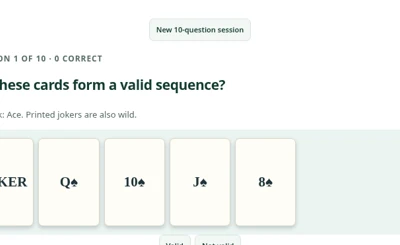
- Start a 10-question session. Read the visible rule label and wild rank, if shown.
- A wild-rank card can be natural in a pure sequence; a printed joker cannot.
- Study the complete hand before answering. Choose Valid or Not valid.
- Read the explanation after submitting. Each question accepts one submitted answer.
- Continue to the tenth question for a session score; start another session for a new selection.
Keyboard and screen controls
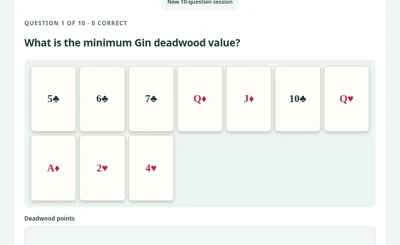
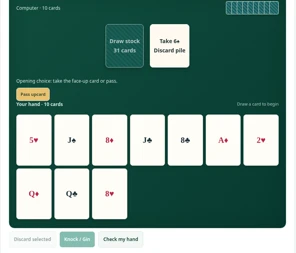
Tap the answer buttons or selected card; the deadwood exercise uses a numeric input. Next question appears after an answer. Return to the explanation when a decision is unclear. For a calm first round, focus on one decision.
A useful example
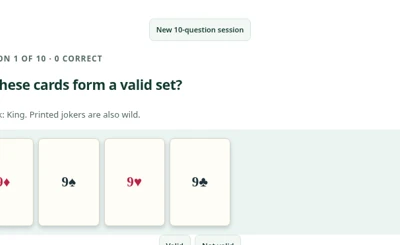
Example hand: 4♥ 3♥ 2♥ A♥. Wild rank 11. The printed ranks are consecutive in one suit, with no joker substitution. Return to the explanation when a decision is unclear.
A useful caution
Use the rule sheet as a reference. Do not call a group pure merely because its ranks look close. Take the next action only when the current step is clear.
Common questions
What is the aim?
Identify same-suit consecutive cards without substituting jokers. A clear plan starts with the current position. The same rule applies on a phone and on a computer.
How do I use the controls?
Tap the answer buttons or selected card; the deadwood exercise uses a numeric input. Next question appears after an answer. Take a moment to read the table. Take the next action only when the current step is clear.
Which format is available?
500 stored and rule-checked questions; ten questions per session. Questions can repeat across sessions. Practice is solo, with no rating, cash reward or account. Begin with the objective. Use another round to revisit a decision.
What should I check before a move?
Do not call a group pure merely because its ranks look close. For a calm first round, focus on one decision. Use another round to revisit a decision.
Can you give an example?
With 4 wild, 3♥ 4♥ 5♥ is still pure because 4♥ is used naturally. A clear plan starts with the current position. The same rule applies on a phone and on a computer.
How many questions are available?
This exercise contains 500 stored questions. A session selects ten without repeating within that session. Work at your own pace. Use another round to revisit a decision.
Can I change a submitted answer?
No. Read the explanation, then continue. Start another session to practise again. For a calm first round, focus on one decision. Check the relevant controls before continuing.
Are the answers checked against the rules?
A wild-rank card can be natural in a pure sequence; a printed joker cannot. Keep the active rule in mind. The same rule applies on a phone and on a computer.
Will I always see new cards?
No. The bank is finite, so another session may include a previously played question. Look at the complete hand before deciding. Take the next action only when the current step is clear.
What does the score measure?
The score is the number of correct answers in this ten-question session. It is not a skill certificate or a prediction of match results. Begin with the objective. The same rule applies on a phone and on a computer.